So, you are looking for a new ride. Maybe you are tired of being stuck in traffic, or perhaps you just want to feel the wind in your hair without breaking a sweat. You’ve probably heard the name floating around, but here’s the thing: when you search for Apollo Go, you might actually run into two different things.
There is the Apollo Go robotaxi service by Baidu—you know, the self-driving cars taking over cities like Wuhan. And then there is the Apollo Go electric scooter from the Canadian brand Apollo Scooters. It gets confusing fast.
Well, today, we are clearing up the confusion. We are diving deep into the Apollo Go e scooter. Why? Because this little machine has become the talk of the commuter world. The folks at WIRED even called it a favorite, and that is not nothing .
We are going to break down the Apollo Go specs, talk about how much it costs, and answer the big question: Is it actually worth your hard-earned cash? Whether you are looking at a brand-new unit or hunting for Apollo Go open box & refurbished reviews, we’ve got you covered. Let’s roll.
Introduction: The “Apollo Go” That Gets You There
Look, the scooter market is packed. You have got cheap Amazon specials that fall apart after one puddle, and you have got hyper-scooters that weigh as much as a small motorcycle. The Apollo Go sits right in the sweet spot.
This is not the flashiest scooter on the block. It won’t hit 60 mph, and it won’t climb a vertical wall. But that is kinda the point. Apollo took a step back and asked, “What does a daily commuter actually need?”
The answer was a lightweight, dual-motor scooter that doesn’t beat you up on rough pavement. It is designed for the person who needs to get to work, grab a coffee, or cruise to the train station without looking like a sweaty mess at the destination.
Apollo Go First Impressions and Design Language
When you pull this thing out of the box, the first thing you notice is the heft—but in a good way. At around 49 pounds (for the latest Stellar model), it has a solid, premium feel . It’s not cheap plastic.
The unboxing experience is pretty straightforward. Inside, you get the scooter, a charger, a toolkit (mostly just a 4mm Allen key), and the manual . The design is clean. Space grey with black accents. It looks like a piece of modern tech, not a toy.
Apollo calls the aesthetic “Thunder 3” on some of their other models, but on the Go, it is more understated. There is a reinforced stem that minimizes wobble—a huge safety win—and the folding mechanism is rock solid. You press a button, flip a latch, and it folds down in seconds. No fighting with it.
Who is the Apollo Go Electric Scooter For?
This is the million-dollar question. Who should actually buy this thing?
It is probably not for you if you are an off-road warrior or if you need to haul 50 pounds of gear up a mountain.
Apollo Go: Full Technical Specifications
Alright, let’s pop the hood. Or, well, the deck. Here is the breakdown of what makes this thing tick. I have pulled together the data from the official specs and retail listings to give you the full picture .
| Specification | Apollo Go (Standard) | Apollo Go Stellar (New Model) |
|---|---|---|
| Motor Power | Dual 350W (Nominal) / 750W Peak | Dual 950W Nominal |
| Top Speed | 28 mph (45 km/h) | 31 mph |
| Battery | 36V / 15.0 Ah | 48V / 13.45 Ah |
| Max Range | Up to 30 miles (48 km) | Up to 32 miles |
| Weight | 49 lbs (22 kg) | 49 lbs |
| Tires | 9.5″ PunctureGuard Tubeless | 9.5″ PunctureGuard Tubeless |
| Water Resistance | IP66 | IP66 |
| Max Load | 265 lbs (120 kg) | 265 lbs |
Powertrain: Motors and Controllers
Here is the pc… the motor setup is clever. It uses dual 350-watt motors (nominal) that peak much higher. Why dual motors on a commuter? Because hills. A single motor scooter struggles on a steep incline. The Apollo Go e scooter gives you that extra push.
The newer “Stellar” model kicks it up a notch with a 48V system and 950W nominal motors . That means faster acceleration off the line. You feel it when the light turns green.
Apollo Go Battery Capacity and Range
Range is always tricky. Manufacturers love to quote numbers based on a 165-pound rider going downhill in Eco mode. In the real world?
If you ride in Sport mode (which is the most fun), expect closer to 15-18 miles. If you baby it in Eco mode, you can squeeze out 25+ miles. WIRED tested it with a tall rider going 15 mph and got about 15 miles, which is solid for a heavier person .
The standard model uses a 36V system with 21700 battery cells . The Stellar bumps that to 48V, which is more efficient and keeps the power consistent even when the battery is low .
Dimensions, Weight, and Payload Capacity
Let’s talk about the numbers that matter for living with it.
- Folded Dimensions: Roughly 46 inches by 20 inches. It fits in the trunk of a sedan.
- Weight: 49 lbs. It is the “Goldilocks” weight. Light enough to carry, heavy enough to feel stable at speed.
- Payload: 265 lbs. That covers most riders.
Performance Benchmarks: On the Road
Numbers are boring until you actually twist the throttle. So, how does it feel?
Acceleration and Top Speed Test
Twist the throttle, and the Apollo Go pulls smoothly. It is not jerky like some cheaper scooters that lurch forward and try to throw you off. The dual motors engage without drama.
0 to 15 mph happens in just a few seconds. It hits the advertised 28 mph (or 31 on the Stellar) without much fuss. At that speed, stability is key. Thanks to the reinforced stem, there is zero death wobble.
Suspension and Ride Quality
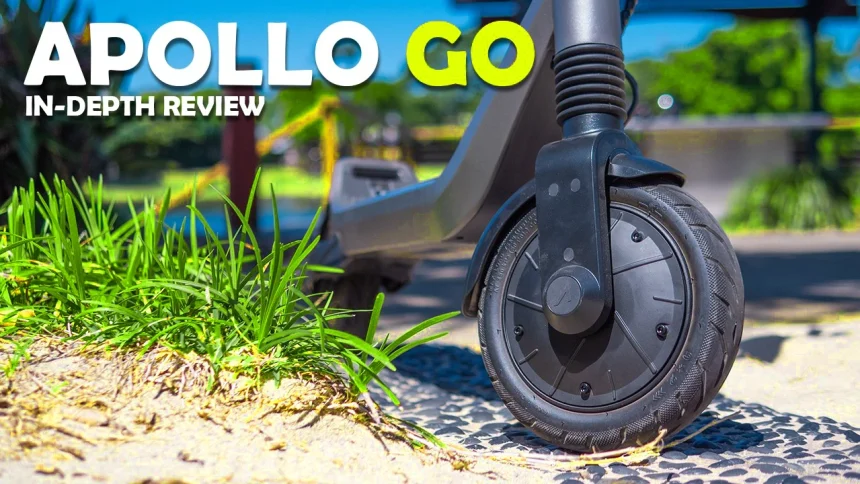
This is where the Apollo Go electric scooter earns its keep. The Apollo Airflow™ suspension gives you over 5 cm of travel . I took this over some nasty brick pathways, and honestly, my teeth stayed in my head.
The front suspension handles the big bumps, while the rear rubber absorber takes the edge off the little vibrations. It is not a magic carpet—you will still feel big potholes—but it is miles ahead of solid-frame scooters.
Braking System Deep Dive
Stopping is just as important as going. The Apollo Go uses a hybrid system:
- Power RBS™ (Regenerative Braking): When you use the left thumb lever, the motors slow you down and send a bit of juice back to the battery. It saves your brake pads.
- Rear Drum Brake: For that final, hard stop.
It is simple and effective. There is no hydraulic brake hassle, which means less maintenance for you.
Hill Climbing and Real-World Grit
I found a 15-degree hill near my house. The dual motors chewed it up. Speed dropped a little, but it never felt like it was going to give up. For the average city environment with bridges and inclines, this scooter laughs at hills.
Apollo Go Build Quality and Technological Features
The frame is cast aerospace-grade aluminum. It feels like a single solid piece. The IP66 water resistance rating is crucial here . You can ride through puddles and light rain without frying the electronics. (Just don’t submerge it).
Display, Controls, and App Integration
Okay, the DOT display is slick. It shows your speed, battery, and mode clearly, even in direct sunlight.
But the real magic is the app. You can:
- Customize acceleration curves
- Adjust the strength of the regenerative brakes
- Lock the scooter electronically
- Use turn-by-turn navigation
It turns a simple scooter into a smart vehicle.
Lighting and Safety Features
Honestly, other scooter brands need to take notes here. The 360-degree lighting means there are lights on the front, sides, and rear. The integrated turn signals are bright and easy for cars to see . If you commute at night, this is a lifesaver.
Apollo Go Price and Where to Buy
Let’s talk money.
Official MSRP and Deals
The standard Apollo Go usually retails around $1,299 to $1,499. However, if you catch it on sale (like the recent spring deals), you can snag it for around $849 . That is a massive discount.
The new Apollo Go Stellar is currently available for reservation with an expected delivery in Q2 2026. The reservation price is just a hold—you pay the final price later .
Open Box and Refurbished Options
If you are hunting for Apollo Go open box & refurbished reviews, here is the deal: Open box units are usually just returns or slightly damaged boxes. The scooter is perfect, and you save 15-20%. Refurbished units have been fixed by Apollo and come with a warranty.
Practical Advice: Always buy refurbished directly from Apollo or an authorized dealer. If you buy it from a random dude on Craigslist, you might not have a warranty.
Living with the Apollo Go
Is it a pain to carry? Sometimes. 49 lbs is 49 lbs. If you have to carry it up five flights of stairs every day, your arms will feel it. But for rolling it into an office or a train, it is fine. The folding latch is sturdy, and it stays folded.
Charging Logistics
Charging takes about 7.5 hours from empty to full using the standard charger . That is an overnight job. If you ride a lot, consider getting a second charger for the office.
Reliability and Support
Apollo has had some customer service hiccups in the past (like many scooter brands). But they have been improving. The app now has in-app support, and there are over 60 certified repair centers . If something breaks, you aren’t totally stranded.
Head-to-Head: Market Comparisons
Apollo Go vs. Apollo Phantom 2.0
The Phantom 2.0 is a beast. 44 mph top speed, 102 lbs weight . It is faster and more powerful, but you cannot carry it upstairs. The Apollo Go is the sensible choice for 90% of riders.
Apollo Go vs. NIU KQi3
The NIU is a great single-motor scooter. It is reliable. But it lacks the hill-climbing torque of the dual-motor Apollo Go. If you live in a flat city, the NIU might save you money. If you have hills, get the Go.
Final Verdict
Pros:
Cons:
The Bottom Line
Here’s the truth. If you are looking for a reliable, fun, and safe way to get around town, the Apollo Go electric scooter is one of the best options out there. It strikes a perfect balance between power and portability. And if you can find it on sale or grab an open-box model? That is a steal.
It is not just a scooter; it is a legit piece of commuting equipment. Whether you are a tech geek who loves the app or just someone who wants to save on gas, the Apollo Go delivers.
Frequently Asked Questions (FAQ)
Is the Apollo Go the same as the Baidu robotaxi?
No. That is a common mix-up. The Apollo Go we reviewed here is a personal electric scooter made by Apollo Scooters for individual riders.
Can I ride the Apollo Go in the rain?
Yes. It has an IP66 water resistance rating, which means it can handle heavy rain and puddles. Just avoid submerging the deck.
How fast does the Apollo Go scooter go?
The standard model hits 28 mph, while the new Stellar model reaches 31 mph .
Where can I find Apollo Go open box & refurbished reviews?
Check the official Apollo Scooters website or trusted retailers like VoroMotors. Reviews for open box units generally state they look and function like new.
How long does the battery last?
Real-world range is about 15-20 miles in Sport mode, and up to 30 miles in Eco mode, depending on your weight.
Does it have a warranty?
Yes. Apollo offers a 12-month limited warranty covering manufacturing defects .