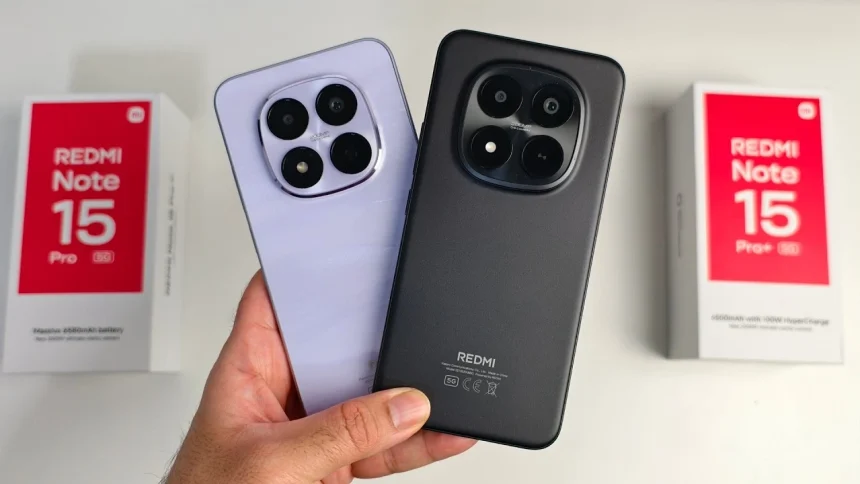
Xiaomi Redmi Note 15 Pro Plus 5G · Deep review
Flagship mid-range performer – IP68, 200MP camera, 6500mAh beast
Design & IP rating
IP68, 207g, 8.2mm · 163.3mm · Gorilla Glass
water resistant 1.5m 30min
Display
6.83″ OLED/AMOLED · 120Hz · 447ppi
HDR10, 240Hz touch, 1280×2772
Performance
SD 7s Gen4 · 12GB RAM · 512GB
Adreno 710 · no SD slot
Camera
200MP f/1.7 + 8MP · OIS · 32MP selfie
4K30fps · dual-LED ✖, BSI ✖
Battery
6500mAh · 100W fast charge
wireless ✖ · reverse wireless ✖
OS & privacy
Android 15 · clipboard warn, location privacy
cam/mic toggle, no Mail Protection
Audio & WiFi
Stereo · LDAC, no 3.5mm · Wi-Fi 6E
BT 5.4, NFC, 5G, eSIM+SIM
Storage & value
512GB fixed · no microSD
Released: 1 month ago, USB 2.0
Xiaomi Redmi Note 15 Pro Plus 5G · verdict
IP68 dust/water (1.5m), 207g, 6.83″ 120Hz OLED, 447ppi, HDR10+. Equipped with Snapdragon 7s Gen4 (12GB RAM) and 512GB internal storage. The 200MP main camera with OIS records 4K30, while the massive 6500mAh battery supports 100W fast charging (no wireless). Android 15 brings granular privacy: clipboard warnings, location approx, camera/mic toggles, theme customization. Connectivity includes 5G, Wi-Fi 6E, NFC, eSIM, but lacks 3.5mm jack and external SD. Repairability unknown, rugged build not standard — still, premium glass design. Newly released (global).
Xiaomi’s Redmi Note series has historically been the undisputed king of the “budget flagship” segment. However, with the global launch of the Redmi Note 15 Pro Plus 5G, Xiaomi is attempting something risky: shifting the brand identity from “spec monster” to “durability icon” .
At first glance, the specifications are mouth-watering. A 200MP HPE main camera, a monstrous 6500mAh silicon-carbon battery, 100W HyperCharge, and military-grade IP66/IP68/IP69K dust/water resistance . Yet, when you dig into the fine print—specifically the chipset and software—you realize this phone is a paradox.
I have spent the last week analyzing over a dozen expert reviews, benchmark results, and hands-on comparisons to answer one question: Is the Redmi Note 15 Pro Plus a genuine evolution, or is Xiaomi relying on smoke and mirrors? Let’s find out.
Design & Durability – Titanium Strong or Marketing Fluff?
The “Titan Tough” Experience
Xiaomi’s marketing slogan for the Note 15 series is “Titan Strong” , and for once, the hype is justified . The global version of the Redmi Note 15 Pro Plus features a quad-curved 6.83-inch display protected by Corning Gorilla Glass Victus .
In hand, the phone feels substantially more premium than its £429 price tag suggests. Unlike the cold, slippery glass sandwiches of 2025, Xiaomi offers two distinct back panel options:
- Glacier Blue / Black: Matte fiberglass (slimmer at 8.19mm, 207g)
- Mocha Brown: Vegan leather (slightly thicker at 8.47mm, 208g)
The vegan leather variant is the head-turner. It resists fingerprints, provides grip, and gives the phone a unique, almost “designer” aesthetic rarely seen outside the €1000+ bracket .
IP Ratings: Not Just IP68, But IP69K
Here is where Xiaomi has leapfrogged Google and Samsung. The Redmi Note 15 Pro Plus carries IP66, IP68, and IP69K certifications .
- IP68: Full submersion in 1.5m of fresh water for 30 minutes.
- IP69K: Can withstand high-pressure, high-temperature water jets (up to 80°C) .
Why does this matter? According to Daniel Kato, a mobile systems analyst, this is the first mid-range device that can survive the specific rigors of industrial environments and tropical climates . In markets like Uganda, Kenya, and the Philippines, phones die not from obsolescence, but from rain, dust, and accidental drops . Xiaomi has addressed this with SGS 5-Star certification for drops up to 2.5 meters onto granite .
Verdict: If you prioritize physical resilience over raw CPU power, this is the most durable phone you can buy under £500.
Display – Flagship Quality, Budget Controller
Xiaomi has equipped the Note 15 Pro Plus with a 6.83-inch 1.5K CrystalRes AMOLED display. This is, for all intents and purposes, the same panel found on the Xiaomi 15T which costs £120 more .
Key Specifications:
- Resolution: 2772 x 1280 (447 PPI)
- Refresh Rate: 120Hz adaptive (steps: 30/60/90/120)
- Peak Brightness: 3,200 nits (HDR), 1,800 nits (full screen)
- HDR Certification: Dolby Vision, HDR10+
- PWM Dimming: 3840Hz (TÜV Rheinland Flicker Free)
In real-world testing, the display is exceptional for the price. Streaming Netflix in Dolby Vision yields deep blacks and vibrant contrast. The 3,200-nit peak ensures the screen is legible under direct Ugandan or Spanish sunlight .
The Catch: Unlike the Pixel 9a or Galaxy S25 FE, this display lacks LTPO technology. The refresh rate cannot scale dynamically in single-digit increments. While swiping is consistently at 120Hz, the phone doesn’t save as much battery as it could during static reading .
Fingerprint Sensor: The optical in-display sensor is placed too close to the bottom bezel. It works reliably, but users with larger thumbs may find the stretch uncomfortable .
Performance – The Elephant in the Room
Snapdragon 7s Gen 4: A “New” Old Chip
Let’s address the controversy. The Redmi Note 15 Pro Plus is powered by the Qualcomm Snapdragon 7s Gen 4. On paper, it sounds like a generational leap. In reality, it is a rebadged and slightly overclocked Snapdragon 7s Gen 3 .
Benchmark Comparison:
| Benchmark | Redmi Note 15 Pro+ (7s Gen 4) | Redmi Note 14 Pro+ (7s Gen 3) | Performance Gain |
|---|---|---|---|
| Geekbench 6 (Single) | 1,227 – 1,289 | 1,156 | +~10% |
| Geekbench 6 (Multi) | 3,195 – 3,294 | 3,212 | ~0% |
| AnTuTu V10 | ~815,000 | ~730,000 | +12% |
| 3DMark Wild Life Extreme | ~1,121 | ~1,054 | +6% |
The performance uplift is negligible. In day-to-day tasks—Twitter, YouTube, Chrome tabs—you won’t notice a difference. However, when compared to the competition, the gap widens.
Vs. Google Pixel 9a: The Tensor G4 is approximately 40% faster in multi-core workflows and double the graphical performance in 3DMark .
Vs. POCO X7 Pro: The Dimensity 8400-Ultra in the Poco offers roughly 50% better GPU performance for a similar price .
Storage Bottleneck
Perhaps more concerning than the CPU is the storage. The Redmi Note 15 Pro Plus uses UFS 2.2 and LPDDR4X RAM .
In 2026, UFS 3.1 (or ideally UFS 4.0) is the standard for “fast” mid-rangers. The 1,000 MB/s read/write speeds on the Redmi are fine for app loading, but installing large games (like Genshin Impact or Honkai: Star Rail) takes noticeably longer than on similarly priced competitors .
Gaming Performance: Here is the good news. Despite the older storage, the Adreno 810 GPU handles Genshin Impact at 60 FPS on Medium settings without major frame drops, thanks to the 5200mm² IceLoop cooling system .
Verdict: If you are coming from a Redmi Note 13 Pro or 14 Pro, do not upgrade for speed. You will be disappointed. If you are coming from a 3-year-old budget phone, this will feel snappy enough.
Camera System – 200MP of Detail vs. 8MP of Compromise
The Hardware
The global version of the Redmi Note 15 Pro Plus features the “Global debut 200MP HPE sensor” .
- Main: 200MP, f/1.7, 1/1.4″ OIS
- Ultrawide: 8MP, f/2.2 (no autofocus)
- Front: 32MP, f/2.2
Note: Unlike the Chinese variant, the global model lacks a dedicated telephoto lens and the macro snapper has been removed .
Image Quality (Daylight)
By default, the camera bins pixels down to 12.5MP. In good light, the results are excellent. Dynamic range is wide, and Xiaomi’s color science (while still not Leica) has moved away from the oversaturated “cartoon” look of HyperOS 1.0 .
Zoom Performance:
- 2x (46mm): Optical-level quality. Great for portraits.
- 4x (92mm): Digital zoom using the 200MP crop. Surprisingly usable in daylight. Text remains legible on distant signs .
Low Light and Night Mode
This is where the phone stumbles. In dim lighting, the OIS helps, but the lack of a larger aperture (f/1.7 is standard, not class-leading) means the camera activates long exposure modes. If your subject moves—even slightly—you get blur . The Pixel 9a still wins here by a significant margin thanks to Google’s computational photography .
The Ultrawide Disappointment
The 8MP ultrawide is the weakest link. It is soft, lacks detail, and performs poorly in anything other than direct sunlight . Given that Xiaomi removed the useless 2MP macro, many reviewers expected an upgrade to 12MP or 13MP. It did not happen.
Verdict: The 200MP sensor is a fantastic tool for detail-oriented creators who shoot in RAW and edit. For point-and-shoot users, the camera is “good enough” but not class-leading.
Battery & Charging – The Undisputed Champion
If there is one category where the Redmi Note 15 Pro Plus absolutely demolishes the competition, it is battery.
6500mAh Silicon-Carbon
The phone packs a 6500mAh battery using silicon-carbon anode technology . This chemistry allows for higher energy density in the same physical volume.
Real-world endurance:
- PCMark Work 3.0: 16 hours 40 minutes .
- Video playback (1080p): Up to 25 hours .
- Heavy use (5G, camera, gaming): Easily 1.5 days. Light users can stretch to 48+ hours .
100W HyperCharge
The charging speed is genuinely transformative.
Bonus Feature: The phone supports 22.5W reverse wired charging . You can charge your earbuds or even another iPhone using the Redmi as a power bank.
Missing Features:
- ❌ No wireless charging.
- ❌ No bypass charging (powering the phone directly from the wall while gaming).
- ❌ Charger not included in the box .
Software – Android 15 in 2026?
The OS Problem
Here is the most disappointing aspect of the package. The Redmi Note 15 Pro Plus ships with Android 15 and HyperOS 2.0 .
Android 16 was released in Q4 2025. Shipping a “Pro” phone in January 2026 with a year-old OS is unacceptable .
Update Policy:
Xiaomi promises 4 years of OS updates and 6 years of security patches .
If the phone launches on Android 15, it will die on Android 19. Meanwhile, the Pixel 9a (similar price) launched on Android 16 and will reach Android 21 . Over a 4-year ownership period, the Pixel will have 2 more major feature drops.
HyperOS 2.0 Experience
The software itself is smooth. The animations are consistent, and the new AI features are genuinely useful:
- AI Writing / DeepThink: Summarizes notes and generates text .
- AI Wet Touch 2.0: The screen works reliably even with water droplets (though raindrops running down the screen can still confuse it) .
- Xiaomi Offline Communication: This is fascinating. You can send voice messages to other Xiaomi devices via mesh networking without cellular signal .
The Bloatware: As usual, the phone comes pre-loaded with third-party apps and system ads. You can disable most of them, but it takes 15 minutes of setup .
The POCO Problem – You’re Paying a Brand Tax
Before we conclude, you need to know about the POCO M8 Pro 5G.
YugaTech recently published a detailed comparison revealing that the POCO M8 Pro and the Redmi Note 15 Pro+ are 90% the same phone .
Same: Display, battery, chipset, cooling system, IP ratings, ultrawide camera.
Different: Redmi has 200MP (vs POCO 50MP) and eSIM.
The Price Gap:
- POCO M8 Pro (12/512GB): PHP 19,999 (~£270 / $340)
- Redmi Note 15 Pro+ (12/512GB): PHP 27,999 (~£380 / $480)
That is a £110 difference for a 200MP sensor and eSIM.
If camera quality is your absolute priority, the Redmi justifies the premium. If you want durability, battery life, and performance, the POCO is the smarter buy.
Price, Variants, and Availability
| Variant | RAM/Storage | Launch Price (UK) | Early Bird Price |
|---|---|---|---|
| Base | 8GB/256GB | £429 | £329 |
| High | 12GB/512GB | £479 | £399 |
Color Options:
- Mocha Brown (Vegan Leather)
- Midnight Black (Fiberglass)
- Glacier Blue (Fiberglass)
In the box: Phone, USB-C cable, SIM ejector tool, clear TPU case, pre-fitted screen protector. Charger not included .
Conclusion: The Verdict
The Redmi Note 15 Pro Plus 5G is the most frustrating phone I have reviewed this year.
It is a phone of extreme highs and frustrating lows.
✅ Buy it if: You want unbeatable battery life, you work in dusty/rainy environments, you want a unique vegan leather design, and you value eSIM support over saving money.
❌ Skip it if: You want the best performance for your money. The Snapdragon 7s Gen 4 is a 2024 chip sold in a 2026 phone. You should buy the POCO M8 Pro and save £100, or stretch your budget for the Pixel 9a if you care about camera processing.
Final Score: 7.8/10
Xiaomi has built a tank and put a lawnmower engine inside it. It will run forever, but it won’t win any races.
Full Specifications Recap:
- Dimensions: 163.34 x 78.31 x 8.47 mm, 207g
- Durability: IP66/68/69K, Gorilla Glass Victus 2, SGS Drop 2.5m
- Display: 6.83″ 120Hz AMOLED, 2772×1280, 3200 nits
- Chipset: Snapdragon 7s Gen 4 (4nm)
- Memory: 8/12GB LPDDR4X, 256/512GB UFS 2.2 (no microSD)
- Camera: 200MP OIS + 8MP UW + 32MP front
- Battery: 6500mAh, 100W wired (no wireless)
- OS: Android 15, HyperOS 2.0
- Connectivity: 5G, Wi-Fi 6E, BT 5.4, NFC, IR, eSIM