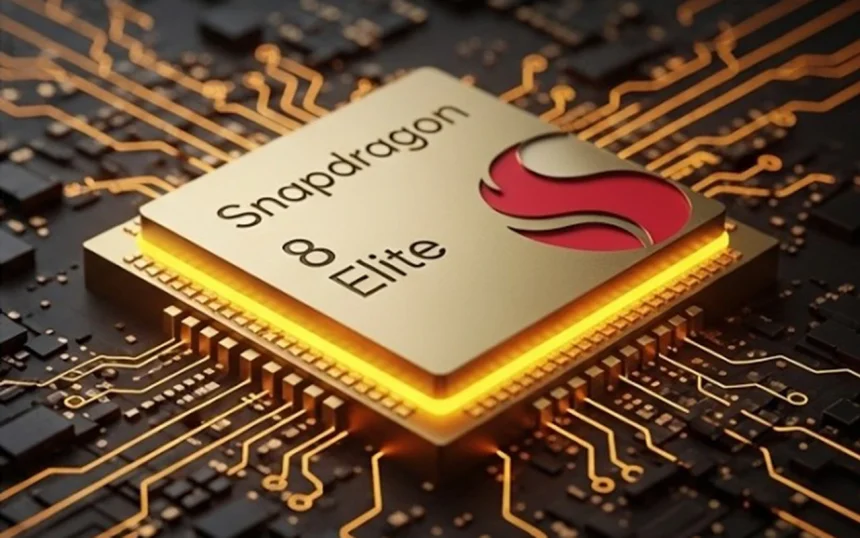

Snapdragon 8 Elite Gen 5
$280
Qualcomm Snapdragon 8 Elite Key Features
Here’s what stood out during my week with the chip:
- CPU Power: The Oryon cores are legit. For multi-tasking maniacs like me, the 14-15% real-world gain over the previous Elite chip is palpable .
- GPU & Gaming: If you’re a gamer, this is the chip to beat. The 17% uplift in ray tracing is visible in supported titles, and the new Adreno HPM (High Performance Memory) cache helps keep things smooth .
- APV Video Capture: This is a sleeper hit. The Advanced Professional Video (APV) codec is the first of its kind on a phone . It essentially records in a format that gives you way more flexibility in post-production to adjust colors without destroying the image quality. For content creators, this could replace a point-and-shoot.
- The X85 Modem: It’s a modem, so it just works. But hitting theoretical speeds of 12.5 Gbps down means you’ll never have to think about connectivity again .
- Battery Life: Qualcomm claims a 35% efficiency boost on the CPU . In my mixed usage (Wi-Fi, 5G, GPS), the phone consistently lasted about an hour and a half longer than my previous generation device. It’s not a two-day phone, but it takes the edge off the anxiety.
The Pros and Cons (Balanced and Honest)
Pros:
- Blistering Speed: It is, without a doubt, the fastest mobile chip on the market right now. It absolutely crushes multi-core workloads .
- Efficient Architecture: The move to 3nm N3P and the cache improvements mean you’re getting more juice without always draining the battery .
- Creator Focused: The APV codec and triple 20-bit ISP turn your phone into a legitimate video tool .
- Future-Proofed AI: The NPU is overkill for today, but that means it will handle the apps of 2026 with ease.
Cons:
- Diminishing Returns: If you’re on a Snapdragon 8 Elite (Gen 4) phone, do not rush to upgrade. You won’t feel a massive difference in daily use .
- Thermal Throttling: It still gets hot. Really hot. While sustained performance is better, hitting 56°C on a gaming phone is concerning for standard slab phones .
- Marketing Hype: The 23% GPU claim is a “best case scenario.” In real-world retail units, it’s closer to 13-17% .
- It’s Overkill: 99% of users will never utilize 50% of this chip’s capability.
Qualcomm Snapdragon 8 Elite Who Is It Really For?
If you’re a gamer or a mobile content creator, this is the chip you want. Period. The visual fidelity and the post-production flexibility are unmatched right now.
If you’re a power user who juggles a million apps and hates waiting, you’ll appreciate the fluidity.
If you’re just scrolling social media, texting, and taking casual photos? Your current phone is probably fine. The Snapdragon 8 Elite Gen 5 is a marvel of engineering, but it’s a marvel built for the future.
Comparison: How Does It Stack Up?
- vs. Apple A18 Pro: Qualcomm wins in multi-core and graphics. Apple still holds a tiny lead in single-core, but honestly, they are so close now that the “winner” is determined by the OS, not the chip .
- vs. MediaTek Dimensity 9200: This is a closer fight. MediaTek’s “all big core” design is efficient, but Qualcomm’s custom Oryon cores and superior GPU peak performance keep it in the lead, especially for gaming .
Final Verdict (Human, Not Salesy)
Look, the Qualcomm Snapdragon 8 Elite Gen 5 is the new king. The benchmark scores prove it. The real-world feel proves it. It’s fast, smart, and surprisingly efficient given the horsepower under the hood.
But I’m not going to tell you to run out and buy a new phone just for this chip. That would be disingenuous. Your current flagship is still great. However, if you’re upgrading from something two or three years old, or if you want the absolute best mobile gaming rig money can buy, this is the golden ticket.
It’s not perfect—the heat is still an issue physics hasn’t solved yet—but it’s a confident step forward. It feels like Qualcomm stopped trying to catch up and started trying to define where we’re going.
FAQ
1. Is the Qualcomm Snapdragon 8 Elite Gen 5 better than the iPhone 17 Pro’s chip?
Yes, in most metrics. It significantly outperforms the A19 Pro in multi-core CPU tasks and graphics tests, though single-core performance is very close .
2. Will theQualcomm Snapdragon 8 Elite Gen 5 make my battery life better?
It can. The chip itself is up to 35% more efficient than the previous generation, so under similar workloads, you should see improved battery life compared to older chips .
3. What is “Agentic AI” on the Snapdragon 8 Elite Gen 5?
It refers to the chip’s ability to run complex AI models on-device that can understand context across different applications and perform tasks autonomously, like summarizing messages or editing media, without sending your data to the cloud .
4. Does the Snapdragon 8 Elite Gen 5 overheat?
Under extreme, sustained loads like high-end gaming or stress tests, it does get hot (up to 56°C) and will throttle performance to cool down. However, sustained performance is better managed than in previous generations .
5. Which phones will have the Snapdragon 8 Elite Gen 5?
Major brands like Samsung (Galaxy S26 series), Xiaomi (Mi 17 series), OnePlus, ASUS ROG, and Sony have confirmed devices featuring this chip
| ⚙️ Artificial Intelligence (AI) Engine | |
|---|---|
| Qualcomm® Hexagon™ Processor Features | Dedicated power delivery system, Fused AI Accelerator architecture, Hexagon Direct Link, Micro Tile Inferencing, Qualcomm® Hexagon™ Scalar Accelerator, Qualcomm® Hexagon™ Tensor Accelerator, Qualcomm® Hexagon™ Vector eXtensions (HVX) |
| Qualcomm® Sensing Hub Features | Dual always-sensing cameras, Dual-core AI processor |
| 🧠 CPU | |
| Name | Qualcomm® Oryon™ |
| Architecture | 64-bit |
| Clock Speed | 4.74 GHz¹ |
| 🎮 GPU | |
| Name | Qualcomm® Adreno™ |
| APIs | OpenCL™ 3.0 FP, OpenGL® ES 3.2, Vulkan® 1.3 |
| 📶 Cellular Modem-RF | |
| Modem Name | Qualcomm® X85 5G Modem-RF System |
| Peak Download Speed | 12.5 Gbps |
| Peak Upload Speed | 3.7 Gbps |
| Cellular Modem-RF Specs | 10CC aggregation in mmWave, 6CC aggregation in 5G sub-6GHz, 400 MHz carrier aggregation (DL) |
| Performance Enhancement Technologies | NTN Satellite Communication, Qualcomm® 5G AI Processor, Qualcomm® 5G PowerSave, Qualcomm® Advanced Modem-RF Software Suite, Qualcomm® RF Downlink Boost, Qualcomm® RF Uplink Optimization, Qualcomm® Smart Transmit™ technology |
| Cellular Technology | 5G NR TDD, sub-6 GHz, LTE, WCDMA, GSM/EDGE, CBRS, mmWave, sub-6 carrier aggregation (FDD-FDD), sub-6 carrier aggregation (TDD-TDD), 5G FDD, sub-6 carrier aggregation (FDD-TDD), 5G SA (standalone), 5G NSA (non-standalone), FDD UL MIMO, Switched Uplink, 3GPP R18-ready (5G Advanced-ready), 6xCA sub-6 downlink carrier aggregation, 1024-QAM sub-6, FR1 + FR2 CA, TDD UL MIMO |
| Multi SIM | Dual SIM Dual Active (DSDA) |
| 📡 Wi-Fi | |
| Wi-Fi/Bluetooth System | Qualcomm® FastConnect™ 7900 |
| Peak Speed | 5.8 Gbps |
| Generation | Wi-Fi 6, Wi-Fi 6E, Wi-Fi 7 |
| Standards | 802.11a, 802.11ac, 802.11ax, 802.11b, 802.11be, 802.11g, 802.11n |
| Spectral Bands | 6 GHz |
| Channels | 318 MHz |
| Peak QAM | 4K QAM |
| Features | High Band Simultaneous (HBS) Multi-Link, Miracast, MU-MIMO (UL/DL), OFDMA (UL/DL), Passpoint, Target Wake Time (TWT), TDLS, Voice-Enterprise, Wi-Fi Aware R3, Wi-Fi Location, Wi-Fi Optimized Connectivity, Wi-Fi QoS Management, XPAN Technology |
| 🔷 Bluetooth | |
🔷 Bluetooth 6.0 & FastConnect 7900 | |
| Specification Version | Bluetooth® 6.0 |
| Connection Technology | Bluetooth® Low Energy |
| Audio Technologies | Qualcomm® aptX™ Adaptive, Qualcomm® aptX™ Lossless, Qualcomm® aptX™ Voice, Snapdragon Sound™ |
| Key Features | Channel sounding for accurate pairing, LE Audio support, Broadcast Audio, Auracast™ ready |
| 📏 UWB | |
| Standards | Fine Ranging (FiRa), IEEE 802.15.4z |
| 📍 Location | |
| Location Support | Qualcomm® Location Suite |
| Satellite Systems | Beidou, Galileo, GLONASS, GPS, NavIC, QZSS |
| Frequency Support | Triple |
| Accuracy | Sidewalk-level |
| Features | Concurrent satellite systems, Sensor-assisted Navigation |
| 📱 NFC | |
| Near Field Communications | Supported |
| 📷 Camera | |
| Image Signal Processor (ISP) Name | Qualcomm® Spectra™ |
| Image Signal Processor (ISP) Type | Artificial Intelligence ISP (AI ISP) |
| Image Signal Processor (ISP) Number | Triple ISP |
| Image Signal Processor (ISP) Bit Depth | 20-bit |
| Triple Camera (MFNR, ZSL, 30 fps) | 48+48+48 MP |
| Single Camera (MFNR, ZSL, 30 fps) | 108 MP |
| Single Camera | 320 MP |
| Features | AI-based auto-exposure, AI-based auto-focus, AI-based face detection, Locally Motion Compensated Temporal Filtering (MCTF), Multi-frame Noise Reduction (MFNR), Real-time Semantic Segmentation, Truepic photo capture, Engine for Visual Analytics 5.0 |
| Video Capture | 4K @ 120 fps |
| Slow Motion Video Capture | 1080p @ 480 fps |
| Video Capture Formats | Dolby Vision®, Google Ultra HDR, HDR10, HDR10+, Hybrid Log Gamma (HLG) |
| Video Capture Features | 4 exposures (with QDOL image sensors), Bokeh Engine (version 2), Computational HDR with staggered imaged sensors, Real-time Semantic Segmentation, Video super resolution |
| Video Playback Resolution | 8K @ 60 fps |
| Video Playback Codecs | AV1, Dolby Vision®, H.264 (Advanced Video Coding (AVC)), H.265 (High Efficiency Video Coding (HEVC)), HDR10, HDR10+, Hybrid Log Gamma (HLG), VP8, VP9, APV |
| Video Playback Features | HDR Vivid, Engine for Visual Analytics 5.0 |
| 💾 Storage | |
| UFS | UFS 4.1 |
| 🖥️ Display | |
| Maximum On-Device Display Resolution | QHD+ @ 240 Hz |
| Maximum External Display Resolution | 8K @ 30 Hz |
| High Dynamic Range (HDR) | Dolby Vision®, HDR10, HDR10+, HDR Vivid |
| Color Depth | 10-bit |
| Color Gamut | Rec. 2020 |
| 🎧 Audio | |
| Qualcomm Aqstic™ technology support | Qualcomm Aqstic™ audio codec, Qualcomm Aqstic™ smart speaker amplifier |
| Qualcomm® aptX™ audio technology support | Qualcomm® aptX™ Adaptive, Qualcomm® aptX™ Lossless, Qualcomm® aptX™ Voice |
| Audio Processing Technologies | Snapdragon Sound™ technology |
| ⚡ Charging | |
| Qualcomm® Quick Charge™ technology support | Qualcomm® Quick Charge™ 5 technology |
| 🔒 Security | |
| Fingerprint Sensor | Qualcomm® 3D Sonic Sensor Max |
| Secure Processing Unit (SPU) | Biometric Authentication (Face), Biometric Authentication (Fingerprint), Biometric Authentication (Iris), Biometric Authentication (Voice) |
| Features | Qualcomm® Trusted Execution Environment (TEE), Qualcomm® Type-1 Hypervisor, Qualcomm® Wireless Edge Services (WES), Secure Processing Unit (SPU), Trust Management Engine |
| 🧮 Memory | |
| Speed | 5300 MHz |
| Type | LPDDR5x |
| 🔌 Universal Serial Bus (USB) | |
| Interface Type | USB-C |
| Specification Version | USB 3.1 Gen2 |
| 🔬 Process Node and Technology | |
| Process Node | 3 nm |
| Part Number(s) | SM8850-AC, SM8850-1-AD, SM8850-5-AC2 |